
This is a long post but a post I think it’s worth your time. If you will commit to studying the Church Fathers I think you will find their stories and testimonies will impact your life significantly.
The Apostle Paul wrote in Philippians 1:21 “For to me to live is Christ, and to die is gain.” To die is gain? This concept seems almost completely ridiculous to Christians living in the Western world right now. There is a certain disconnect between Christians living in 2013 and the Christians who lived during the 1st, 2nd, 3rd, and 4th centuries. Christians who lived during the beginning of Christianity understood what the Apostle Paul was talking about when he wrote on the topics of bodily death, suffering, and persecution simply because of being a Christian.
Christians living in the 21st century in the Western world do their best to digest and relate to the bold words written in Philippians 1:21, however, with little to no actual suffering experienced by most believers in the Western world today, this idea is largely missing from the average persons vocabulary. This was not the case with Ignatius of Antioch who lived during the early 2nd century. Ignatius fully grasped what it meant to die for Jesus Christ, unlike the Western Christians of present time. Ignatius of Antioch is best known for the powerful letters he wrote. Famed Christian scholar Bruce Metzger writes of Ignatius of Antioch’s 7 letters “such strong faith and overwhelming love of Christ as to make them one of the finest literary expressions of Christianity during the second century.”[1]
Outside of the 7 letters that Ignatius of Antioch authored himself to churches in Asia Minor, not too much is known about his history, or the events that led up to his death. What is known about Ignatius of Antioch however, makes him worthy of mention in all Christian history books, and history books covering 2nd century in general. Ignatius of Antioch held the prestigious position of Bishop of Antioch. Antioch was one of the largest cities of biblical times. Ignatius’ Bishop Position left him in charge of the churches in the Antiochien region. To better understand the situation in Antioch, Christian historian Bryan Litfin writes “Antioch surely deserves to be named among the foremost cities of the ancient world. The Jewish historian Josephus claimed that after Rome and Alexandria ‘without dispute, Antioch deserves the place of the third city in the habitable earth that was under the Roman Empire, both in magnitude and other marks of prosperity’”.[2]
Litfin further writes “Antioch was founded as a Greek city in 300 BC in the wake of Alexander the Great’s conquests. In Ignatius’s era, four hundred years later, it was the capital of the Roman province of Syria, with about half a million residents.”[3] Antioch was a densely populated region and Ignatius was the leader of the Church in this region. He held the distinguished leadership position of Bishop in the Christian Church. He was a great man of faith, and was well respected in the Christian community. Church Father John Chrysostom wrote that Ignatius “soul was boiling with passionate divine love.”
What were the 7 letters authored by Ignatius of Antioch about? Litfin writes “The seven letters of Ignatius were written to various churches in Asia Minor, but many scholars believe the topics he addressed also reflected his own pastoral concerns in Antioch. If this is true, the letters reveal that Ignatius faced opposition in his home church on two main fronts. One of these (as we have seen) was a legalistic Jewish expression of the faith who’s roots go back to the very beginnings of Christianity in Antioch. The other was Gnosticism…”[4]
Michael A.G. Haykin adds to Litfins observations writing “It is evident that three concerns were uppermost Ignatius’s mind as he wrote his letters. First of all, he longed to see unity in every level in the life of the local churches to which he was writing. In his own words he was a man dedicated to the cause of unity…Thus, his second major concern was an ardent desire that his fellow believers stand fast in their common faith against heresy…Finally, Ignatius was eager to recruit the help of his correspondents in the successful completion of his own vocation, which was nothing less than a call to martyrdom.”[5]
Many of the Christians living in this area came from Jewish roots, and thus dealt with some of the issues that the Apostle Paul wrote about in some of his Epistles to predominantly Jewish Christian communities. Undoubtedly the legalism practiced by the 1st and 2nd century Jews, and the Christians with Jewish backgrounds, conflicted significantly with the non-legalistic gospel message that the inspired authors of the New Testament promoted. The Christians of the Antioch community with Jewish roots were part of the problem. They considered themselves to be pure Christians, who were better than the gentile Christians who didn’t come from the Jewish faith.
Bryan Litfin writes “but the very thing that had first attracted Gentile converts to the Christian faith – its Jewishness – soon turned into one of the Antiochene church’s biggest problems. Conservative elements within the community warned that the ritual law could not be so easily abandoned. Even many Gentile believers in Antioch viewed Judaism as a venerable religion with fascinating rites and customs that ought to be retained in the Christian church.”[6]
The conflict consisted of blending Judaism with Christianity, and undoubtedly resulted in confusion and elitism between the Jewish Christians and the Gentile believers as well.
Naturally this conflict was dangerous to 1st and 2nd century Christianity, and as such motivated the Apostle Paul to deal with the issue with force. Bishop Ignatius also had to deal with this situation in his community of believers so that further divisiveness and disunity would be quashed before it got out of control. Ignatius wrote “let us learn to live according to the principles of Christianity. For whosoever is called by any other name besides this is not from God. Lay aside, therefore, the evil, the old, the sour leaven, and be changed into the new heaven, which is Jesus Christ… It is absurd to profess Christ Jesus, and to Judaize.” [7]
Gnosticism was another serious problem for Christianity in its early years. Apparently this heresy infiltrated the Antioch Christian community as well. Bryan Litfin writes “The roots of the Gnostic heresy in Antioch go back to the earliest days of the church there. In Acts 6:5 we read of an Antiochene Gentile named Nicolaus who had converted to Judaism and then to Christianity. Some early church fathers testified that Nicolaus did not remain in the true faith, for he is reported to be the founder of the immoral sect mentioned in Revelation 2:6…”[8] Litfin continues saying “Several Gnostic teachers were connected with Antioch, such as Menaner, Saturninus, Basilidies, and Cerdo.”[9]
The combined duo of Gnosticism and the Jewish-Christian identity crisis undoubtedly left Ignatius of Antioch with a full plate of ministerial duties. In one hand he was combating the heresy of Gnosticism and Docetism, and on the other he was fighting against the Judaizing of the recent converts to Christianity. Clearly, these things created a large amount of disunity among Christians of the 1st and 2nd centuries, especially in the diverse community that Ignatius shepherded in Antioch. Despite the conflict he experienced while in the ministry, Ignatius also had his mind fully committed and prepared to giving up his life as a martyr for his faith in Jesus Christ.
Interestingly enough, the word Martyr did not always correlate with death as we understand it today. Michael A.G. Haykin writes “Our word Martyr is derived from the Greek martys, originally a juridical term that was used of a witness in a court of law. Such a person has direct knowledge or experience of certain persons, events or circumstances and is therefore in a position to speak out and does so.”[10] The word later came to be associated with death because of all of the Christians who were killed in the Asia Minor region after giving witness to their Christian beliefs, and outright refusal to deny Jesus Christ. This was also the case with Ignatius of Antioch as well.
We don’t know exactly what events led up to the arrest of Ignatius. He likely was arrested for the same reason many other Christians were arrested in the first few centuries after Christ’s death on the cross. The common accusation was made by the Roman authorities that the Christians refused to worship the pagan Gods. The Roman Empire accused Christians of being atheists. Since the Christians refused to submit to the will of the Roman Empire, they were subsequently accused of refusing to submit to the Roman Empire as a whole. For this reason, 1st and 2nd century Christians were often arrested by the Roman Empire and frequently sentenced to death. As an authority figure in the Christian church, operating out of an important and busy region, Ignatius was in the public spot light, and was therefore arrested for being a Christian.
We also don’t know the exact time frame of Ignatius arrest. Michael A.G. Haykin writes “Ignatius was arrested in the city of Antioch somewhere between 107 and 110 and sent to Rome for trial.” [11] It is suggested that Ignatius was a citizen of Rome because he was transported to Rome for his case to be heard by the Emperor, and that was a right of citizens of the Roman Empire. Rome assigned 10 guards to transport Ignatius from Antioch to headquarters in Rome. This story sounds an awful lot like the stories the Apostle Paul documents in the book of Acts. Ignatius had to have been familiar with the writings of the Apostle Paul, and had to have known that his direct appeal to the Emperor of Rome would not be met with much compassion or enthusiasm. Ignatius knew that his death was certain, and actually spent much time preparing to give up his life for Jesus Christ.
He was proud of his certain death, and wrote about it on numerous occasions. He also had connections in Rome and was concerned that someone might try to intervene on his behalf to prevent his imprisonment and eventual execution. Ignatius urged these people to not interfere with his eventual martyrdom. He appealed to his connections throughout Christianity urging them that this was how committed to the cause of Christianity he was! Ignatius also kept in mind all of the believers who lived in Rome.
Throughout the duration of his plight, he never stopped thinking as a pastor, and kept a compassionate heart for the churches and communities he had the pleasure of ministering to. For example, Ignatius wrote to the church at Rome “It is the hope of this world’s prince to get hold of me and undermine my resolve, set as it is upon God. Pray let none of you lend him any assistance, but take my part instead, for it is the part of God. Do not have Jesus Christ on your lips, and the world in your heart; do not cherish thoughts of grudging me my fate. Even if I were to come and implore you in person, do not yield to my pleading; keep your compliance for this written entreaty instead.”[12]
Christians were always on his mind. He was obsessed with the well-being and growth of the Christians of the 2nd century. He appealed to the Christians in Rome much like the New Testament authors did, urging them to talk the talk, and walk the walk, being consistent in their Christianity regardless of the consequences of doing so.
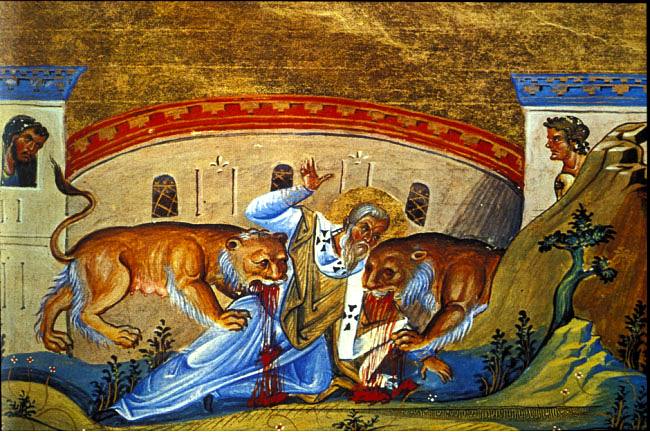
Ignatius wrote “Leave me to be a meal for the beasts, for it is they who can provide my way to God. I am his wheat, ground fine by the lion’s teeth to be made purest bread…Fire, cross, beast-fighting, hacking and quartering, splintering of bone and mangling of limb, even the pulverizing of my entire body – let every horrid an diabolical torment come upon me, provided only that I can win my way to Jesus Christ.”[13] One thing that is very important to keep in mind while reading Ignatius potent words is “As Ignatius’s remarks about martyrdom in his letters are read, one fact above all must be kept in mind. In the words of William C. Weinrich, Ignatius reflects upon his own coming martyrdom. This explains the passionate nature of some of his statements. It also means that we should not take these letters to be a systematic theology on martyrdom. Ignatius speaks for himself and about himself. Again, Weinrich comments ‘What he says, he says about himself as one who is going into death because he is a Christian.’” [14]
Ignatius reveals much about the martyrdom of Christians in the 1st and 2nd century in his writings. He, along with several of the other Church Fathers, refer to the brutal gladiator games that were loved by so many people within the Roman Empire. Often times, defenseless men and women were thrown into an arena where angry beasts and trained warriors were encouraged to rip them to pieces, all for the purpose of entertaining the people in the stadium. This outrageous violence was directly responsible for the death of many Christians in particular. Ignatius knew that his death may come from the Gladiator events, and that if it were, it would be excruciatingly painful. He knew that his death would likely come from being ripped into pieces by beasts, and yet he did waiver from his resolve to have this done to him. He would not deny Christianity and profess his undying loyalty to the Roman Empires pagan religion. His level of commitment is on par with the Apostle Paul, James the brother of Jesus, Stephen, and many of the other 1st Century Apostolic Church Fathers.
All Christians living in the Western world today have much to learn from the distinguished 1st century Bishop of Antioch Ignatius. His patient long suffering, formidable acceptance of the biblical message of sacrifice, and willingness to lay down his life for his faith, are all characteristics that modern Western believers can stand to learn from today. While modern Christians should not walk around obsessing about their death, they should come to a point in their walk with the Lord where they can readily profess “to die is gain.”
Christians are often easily offended by criticism, and consider that to be the modern equivalent of taking up ones cross. The removal of Christian values and teachings from the public realm along with the outright secularization within the public academic arena have left many Christians claiming persecution and unfair treatment. Very few of these people have ever been imprisoned for their faith though. Very few of these people have been beaten, tortured, or killed for their faith in Jesus Christ. Very few of these people have lived in the shoes of Jesus, the Apostle Paul, or Ignatius of Antioch, knowing that death is certain for those who profess Christ as Lord.
This is why we must study the Church Fathers. We must familiarize ourselves with the blessed letters of the men and women who came before and gave up their lives for Christ. With such an easy lifestyle experienced within Western Christianity today, we have to constantly remind ourselves of the tremendous persecution and suffering that our Christian brothers and sisters experienced. If we don’t prepare ourselves, we will continue to shout injustice over the small things and become delusional in our comprehension of what suffering for Jesus Christ really is.
Ignatius of Antioch was a hero of Christianity past, and all Christians who are living today should be thankful that men and women like him were willing to give up their lives to pass along the Christian faith.
References:
[1] Bruce Metzger, The Canon of the New Testament: Its Origin, Development, and Significance (Oxford: Clarendon, 1987), 44
[2] Bryan M. Litfin, Getting to Know the Church Fathers: An Evangelical Introduction (Grand Rapids: Brazos Press, 2007), 33.
[3] Ibid., 33
[4] Ibid. 36.
[5] Michael A.G. Haykin, Rediscovering the Church Fathers: Who They Were and How They Shaped the Church (Wheaton: Crossway, 2011), 32.
[6] Litfin, Getting to Know the Church Fathers, 37
[7] Ignatius, Letter to the Magnesians 10 (ANF 1:63)
[8] Litfin, Getting to Know the Church Fathers, 39
[9] Litfin, Getting to Know the Church Fathers, 39
[10]Haykin, Rediscovering the Church Fathers: Who They Were and How They Shaped the Church,34
[11] Haykin, Rediscovering the Church Fathers: Who They Were and How They Shaped the Church,37
[12] Ignatius, Romans 7.1-2, in Staniforth, Early Christian Writings, 87
[13] Ignatius, Romans 4.1, 5.3, in Staniforth, Early Christian Writings, 86,87.
[14] Haykin, Rediscovering the Church Fathers: Who They Were and How They Shaped the Church,40
 The Religious Nerd