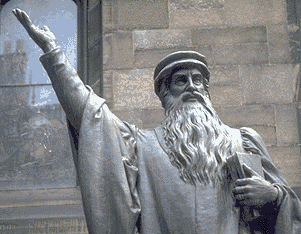
In Douglas Bond’s new book “The Mighty Weakness of John Knox” Bond writes “In 1972, the four hundredth anniversary of his death, it was decided that such a man as Knox was an inappropriate subject to commemorate on a Scottish postage stamp. As a crowning blow, the Edinburgh Town Council ordered the removal of the stone marking his grave, relegating his earthly resting place to obscurity under a variously numbered parking stall. In my most recent visit to Edinburgh, the “JK” once legible on a small square marker was obliterated. As faithless Israel resented Jeremiah’s prophecy of doom and destruction for her whoredom against the Lord, so, for the most part, Scotland has resented the life and ministry of Knox” (Bond Pg.xix) Fascinating, the Scottish people today resent Knox much like many people of his own day.
It isn’t of great surprise that Knox isn’t well known and is often mischaracterized. Many people who dwell in the Arminian and Pelagian camps of modern Christianity are hostile towards anyone who holds to the Calvinistic doctrines of predestination. Instead of analyzing the arguments presented by Knox, Calvin, etc, they simply label them as heretics and do what they can to vilify these great men of god’s reputation with the intent of discrediting them and making Reformed people look stupid. The same thing was going on while these great men of god walked the Earth. John Knox was not immune to controversy over his protestant doctrine. However, God used him to do an amazing work in Scotland that has forever changed the course of Christianity as a whole.
As a young minister, Knox was sent to prison in Scotland where he served a 19 month sentence. During his time sitting imprisoned Knox was able to carefully examine the political and religious situation that Scotland was facing. Scotland had large English and French influences that were loyal to the Church at Rome. Scotland was also a barbarian country and was highly uncivilized unlike many of its fellow European territories. Without a concise system of government and religious establishment the people were at the mercy of Rome and its pawns. Eventually Mary Tudor took the throne and Knox fled to Switzerland to avoid persecution.
Knox’s protestant doctrine found trouble and controversy wherever he went. He eventually ended up in Frankfurt where he was accused of treason by Dr. Richard Cox for speaking disrespectfully about Charles the 5th. Knox left Frankfurt and headed to Geneva where he became friends with John Calvin. Knox and Calvin held similar theological views and both fought valiantly against the corruption of Rome.
Know felt called to return back to Scotland to his people to minister to them and shepherd them. Knox held a preaching position for 10 months and during that time got married. Knox and his wife then left Scotland and eventually moved back to Geneva Switzerland where they lived for another year. Knox had a variety of reasons for his continual moving, chiefly the opposition he faced from the authorities and Romanists. After living in Geneva for less than one year Knox was summonsed back to Scotland in a passionate letter pleading for his return to Shepherd the local flock. Knox debated whether or not he should return and after much consideration was convinced that God had called him to minister to the people of his home land.
When Knox got back to Scotland on October 28th 1557 he returned with a passion to preach the Gospel of Jesus Christ, and with zeal to combat the corrupt English and French that inhabited and ruled over his Scottish brothers and sisters. Knox put together a pamphlet calling out the Mary’s governing the local territory and naturally this outspoken criticism placed him inside the cross hairs. Eventually a minister by the name of Walter Myhn was executed resulting in a growth of the reformation movement’s popularity between the years of 1557 and 1559. During this time the Roman Catholic and protestant relations were at an all-time low. As the movement gained strength, French and English Catholics fled Scotland leaving Knox and his brethren to establish their growing church and government freely.
Eventually the Scottish parliament commissioned Knox and a group of 5 other theologians to write a doctrinal statement, also known as the Scottish confession of faith. While the confession was eventually superseded by the Westminster Confession of Faith (one of the greatest doctrinal statements ever written) the Scottish confession was a well-crafted theological work. This work was extremely important because for a long time the Church at Rome did whatever they could to prevent Christians from thinking for themselves. For example in the first chapter of the Scottish Confession it says “ We confess and acknowledge one God alone, to whom alone we must cleave, whom alone we must serve, whom only we must worship, and in whom alone we put our trust.” (Bond 112) Look at the words used in the confession; cleave, serve, worship, trust. All of these words imply a personal saving relationship with Jesus Christ.
This was the chief end that Knox and his fellow reformers aimed for; that the people they ministered to could have religious freedom, knowledge, and the right to have a personal relationship with Jesus Christ.
Along with the Scottish statement of faith, the parliament also formally declared that Rome no longer had jurisdiction in Scotland. This was a tremendous slap in the face to Rome and the various politicians and monarchy that were in Rome’s back pocket. Rome always needed to have political influence in order to force the people to do their bidding. Knox and his fellow reformers held great success in Scotland and were able to achieve tremendous progress in reforming the Christian Church.
The Christian Church of Scotland had sat stagnant for years under the control of the Roman Catholic Church and Knox knew this first hand given the fact that he was a Roman Catholic Priest in his early years of ministry. He was all too familiar with the corruption and idolatry that came along with Rome and the damage it had done to the common people. Simply put, people didn’t know the gospel, and Knox did whatever he could to make the gospel known. The story of John Knox’s success in Scotland is also a story of one of the Roman Catholic Churches biggest failures.
In 1561, Mary Stuart’s husband died and she returned to Scotland to rule. She brought along with Roman Catholic and French influences. She did her best to defeat Knox and the reformers, and failed miserably. Supposedly, Mary once said “I fear the prayers of John Knox more than all the assembled armies of Europe.” It was too late for Mary and she had to flee from Scotland because the Scottish reformation movement had grown too strong. She fled Scotland and was later put to death accused of attempting to murder Elizabeth I.
The Scottish reformation continued to gain strength and the Presbyterian church was formally established. The Scottish people became more civilized and eventually became some of the most God fearing, God glorifying people of the 16 and 17th centuries. Why such a big turnaround in Scotland? Knox stood firm in his personal prayer life, his Christ-centered preaching, his biblical doctrine, and in his zeal for his countrymen. He was a great man of God who did not compromise his beliefs during overwhelming persecution. Douglas Bond answers why Knox was such a great force in Scotland very eloquently: “What was it about Knox that led English historian James Anthony Froude to conclude that there was “No grander figure in the entire history of the Reformation in this island, than that of Knox?” What enabled such a constitutionally weak man to stand unflinching against political and ecclesiastical tyranny? What enabled him to rally an entire nation, from peasant to parliamentarian, to stand unafraid before the enemies of the Gospel?
Why is it that historians say of such a man as Knox “His was the voice which taught the peasant of the Lothians that he was a free man, the equal in the sight of God with the proudest peer or prelate that had trampled his forefathers?” “There is but one answer. Knox was transformed from weakness to might by God’s power. In this – Knox and all who would be mightily used of God – was like Paul who said “When I am weak, then I am strong” (2 Cor. 12:10b). (Bond 101-102)
Unfortunately in the Christian Church today we often take for granted the mighty accomplishments of John Knox and the other Reformers who were used by God to get the Church where it needs to be; Christ centered. It is important for Christians to study church history and know exactly what happened so that we don’t repeat the same mistakes over and over again. Knox was a hero of the faith. He probably would care less that his grave site was turned into a parking lot as long as his life motivated someone to preach the gospel of Jesus Christ. One thing is for certain; Knox’s successes for Christ in Scotland will never be forgotten – parking lot or not.
Bibliography:
Bond, Douglas. “The Mighty Weakness of John Knox.” Reformation Trust Publishing. 2011.
 The Religious Nerd