
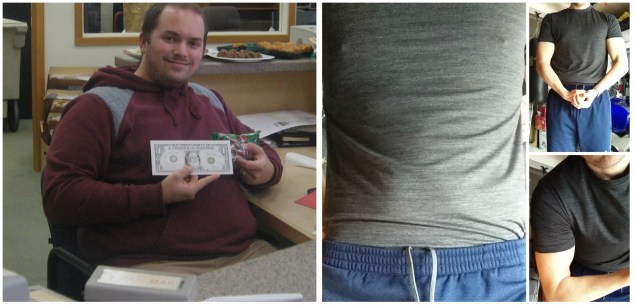
Preface: My story of how I came to be 300 pounds may not be that much different from your own story of how you put on some extra weight, and thus, may be relevant to you regardless of what the scale reads when you step on it. I am not a medical doctor and this series of articles is not meant to replace the advice of your qualified medical professional who you should consult with prior to engaging in any significant lifestyle changes.
How I Came to be 300 Pounds:
I was not particularly depressed nor did I go through some sort of life-changing crisis that caused me to over-eat. I say this because at 300 pounds, I gained weight more rapidly than the “1 pound” per year that the average American puts on (1).
I had an office job and spent the majority of the day sitting at a desk staring at a computer monitor. Many of these habits were created at a previous job where I worked a grave-yard shift and spent the majority of my time seated at a computer where I supervised 10-20 employees who performed manual labor. After my shift came to an end, I would go out to breakfast with a group of my colleagues (most of whom were manual laborers while I was management and had a desk job) before heading home to fall asleep (after consuming a 2,000-calorie meal).
After several months of this new lifestyle, my clothes started to fit tighter, and then I had to purchase new, larger clothes. Eventually I could not fit into the brands I liked and started buying clothes I did not like. Colleagues started noticing the weight gain and cracked the occasional joke at my expense “I see that promotion has been treating you well.” I had already convinced a beautiful woman to marry me and was no longer on the market and therefore focused my attention on my career and education goals. Physical appearance was not at the top of my priority list at the time. In many ways, as a young male working in management at a respectable company in my early twenties, I felt invincible and that there was no way I would ever become defeated by something as simple as weight gain.
Instead, like many Americans, I became addicted to eating fast food, often consuming fast-food two to three times a day and eventually WAS defeated. Fast food in many ways became a drug for me that left me feeling happy when I consumed it, and sad when I abstained, which is not all that different than what happens when a person consumes drugs, alcohol, or engages in any behavior without moderation or balance. While drugs and alcohol can be avoided, food cannot, which makes this problem all the more relevant.
Life was not that great when I was 300 pounds:
I could not walk one block without becoming winded. My sweat was in no short supply and smelled like a wretched concoction of sodium and processed foods. My diet was horrendous and my activity levels were sedentary. I would start the day off with a breakfast sandwich “meal” from my favorite fast-food restaurant, McDonalds. I would then indulge in another high calorie lunch – often of the fast-food variety – consisting of burgers, fries, sodas, milk-shakes, onion rings, pizzas, tacos, burritos, sub-sandwiches, and other “convenient” calorie dense foods that offered minimal nutritional value and left me feeling sickly in every sense of the word.
The thing is, most of my co-workers were eating the same “fast food” lunches that I was, and there would always be long lines at all of the local fast food restaurants I went too, so in essence, I did not believe I was engaging in behavior that was much different from these people (though my waste-band did seem to be expanding much quicker than theirs.)
A quick Google search indicates that the average American will pack on 1 pound per year from the age of 25 on (1). Additionally, over 1/3 of Americans are considered clinically obese (2) while upwards of 75% of Americans are considered “overweight” (3).
I think it is safe to assume that only a small portion of these “overweight” or “obese” individuals qualify as such due to copious amounts of muscle mass brought on by lifting heavy weights over extended periods of time. The majority of these 75% are not Arnold Schwarzenegger by any means. It isn’t just “Americans” who are overweight or obese either, a recent article I read indicated that nearly 2 BILLION people globally are either overweight or obese (4). 2 billion people suffer from the same condition (s) that I suffered from, many of these people are stuck or going backwards.
2 billion people overweight or obese? Many of whom are medical doctors, engineers, lawyers, computer scientists, PhD’s and a variety of other geniuses who operate at the top of their field. The President of the United States is OBESE. Many millionaires and even billionaires are overweight or obese.
Yet, they all must be slothful (calories in) and lazy (calories out) despite having spent decades working tirelessly to obtain the knowledge, skills and credentials needed to excel in their respective field. Have you ever visited a hospital and encountered overweight or obese doctors or nurses? I have, and they have been EXCELLENT at what they do. If only these 2 billion people had access to the brilliant advice to just “eat less and move more,” their weight would simply melt away (insert sarcasm here).
A Medical Crisis Was Not Enough to Cause Me to Change:
After packing on a good 50+ pounds, I decided to seek the advice of my general practitioner, who reiterated the advice that I had previously obtained elsewhere; to exercise more and eat less. The doctor did not leave me with any specific formula for achieving this goal, he more or less implied it was as simple as “calories in and calories out” (which I have come to know as a failed long-term philosophy.) My doctor increased my blood-pressure medication (I have hereditary blood-pressure issues unrelated to my weight gain/loss story, though certainly impacted by it) and put me on acid-reflux meds, which were necessary as a direct result of gaining a lot of weight.
My doctor also warned me that my glucose and A1C readings were increasing and that given that some of my family members suffer from obesity and type 2 diabetes, it would be in my best interest to make the necessary changes to avoid that (diabetes) diagnosis. I had already received the diagnosis of “obesity”; the medical establishment uses the standard BMI formula to determine that, but was also flirting with that pre-diabetes diagnosis for 2-3 years.
I started to suffer from chest pains and what felt like an irregular heart-beat. I went in one time after experiencing some especially concerning chest pain and the doctor took and X-Ray. I received a somber call from my physician the next day indicating that the results were not good. According to the doctor, I had an enlarged heart, and it was fatal condition. The call left me feeling like a tremendous failure. After all, I had done this to myself, and now I would be leaving my wife a widow. My life flashed before my eyes, I spent the night on my knees begging God to spare my life.
Given the severity of the situation my doctor brought me in for additional tests. They performed an ultrasound of my heart that was analyzed by a cardiologist. The echo-cardiogram revealed that the X-Ray had provided a deceptive image and that my heart was in fact healthy. Further, the cardiologist believed that my shortness of breath was caused by the excessive amounts of fat that my body had packed on in my mid-section and chest, which undoubtedly had an effect on the X-ray imagery.
Needless to say, I felt like I had dodged a bullet and that God had given me a second chance to make some changes in my life. So I got back at it, trying to lose weight. You would think a story like this would be sufficient motivation for a man to make permanent changes, and yet, in my case at least, that was not what happened. I was knocking on death’s door and still could not muster the necessary strategy to defeat my ailment.
Why?
Because I suffered from a serious lack of knowledge regarding how to succeed and kept trying the same failed methods time again expecting different results.
I suspect you, and the other 2 billion out there like you, may also be stuck (or going backwards) and it is my hope that this series of articles will help you become unstuck and on your way to success.
What Ultimately Enabled Me to Lose 130 Pounds?
You will have to check back for part 2 of this series for the answer to that question.
Until then, I encourage you to spend some time in self-reflection considering whether or not you may be “stuck” in some aspect of your life. My hope is that my series of articles will assist you in overcoming that struggle, whatever it may be, as I believe some of the lessons I have learned in my 2-3 year process of losing 130 pounds and keeping it off can be applied in other areas of life as well.
References:
(1) https://www.sharecare.com/health/weight-loss/how-much-weight-person-gain-lifetime
(2) https://www.cdc.gov/obesity/data/adult.html
(3) https://www.niddk.nih.gov/health-information/health-statistics/overweight-obesity
(4) https://www.usatoday.com/story/news/health/2017/06/12/wide-world-more-than-2b-overweight-obese-globally-study-says/102776692/
 The Religious Nerd