
 It is no secret that I have been critical of social media in the past, specifically your (and my) motives behind the use of it. I have argued that social media is ruining you, provided you with a list of how you can get yourself unfriended or blocked while using it, and recently put together a cute little poem that calls social media a seductress and tease.
One might argue that I have an obsession with social media, given that this is my forth post on the subject.
I have a love hate relationship with social media. On the one hand, I do think the main premise of the popular social networking sites is self promotion. We are asked to create a profile about ourselves, make posts and comments that express our opinions, post pictures of ourselves that tell the world about the things that we like, and a variety of other miscellaneous self-centered behavior, whether done consciously or not.
The other factor I don’t like about social media and the digital era is how dependent young generations have become on electronic devices and impersonal digital interaction. It would be neat to be able to go to a restaurant and not see every young couple glued to their phone during their date night. It would be impressive if people didn’t feel the need to document every moment of their life on Instagram, which I would argue is a form of electronic bragging. Case in point, this seemingly harmless Instagram post that if examined closely, is stacked tall with selfish intention:
“It sure is hot in Cabo right now, look at me in my cute little bikini on the beach! Wish you were here!”
Now on to why I love social media.
I love that it gives me – a nobody – a chance to put my content out there for the world to see. I admit, some of my content is obnoxious and probably shouldn’t be shared. However, there is no other tool that allows me to express myself to such a diverse (and often geographically distant) group of people. There is no other tool that works as efficiently at keeping me up to date with what’s happening in my friends and family’s lives.
I also see it as a mission field, which is why I think it is critical that the local church have a social media presence.
I am not saying that the local church should create social media accounts and engage in political and theological debates that sour people to the Christian Faith. I also don’t think individual pastors should use social media as a platform to engage in political or theological debate either. Churches should use social media for evangelistic purposes, and for edifying current believers.
Churches need to recognize that most people are on social media, and that a positive and encouraging presence will be refreshing and shine the light of Christ.
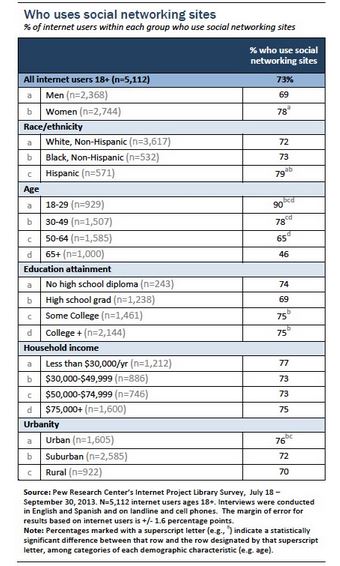
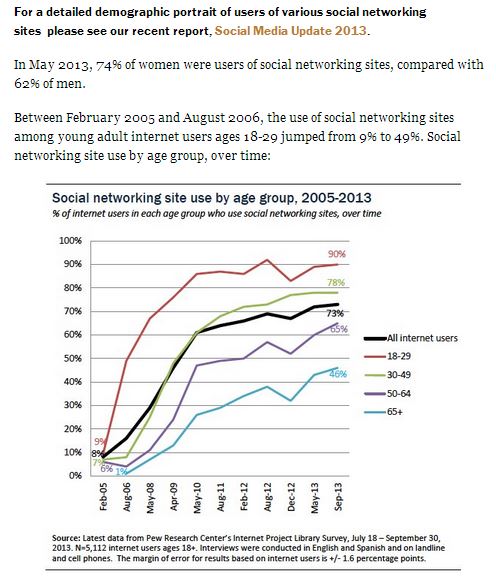
Research shows that most people with internet access use social media. 73% of them. Young generations are twice as likely to be on social media than ages 65+, and minorities are more likely to be on social media compared to white persons. There also seems to be a connection between social media use in an urban settings versus suburban or rural setting.
Another interesting fact is that there are more women on social media than men. Research shows that 74% of women are users of social media compared to 62% of men. Sounds like a great place for a guy to meet a girl, right? (Other than church of course).
Look at this data put together by the people at the Pew Research Center:
What conclusions can be made?
- Social media should not be ignored. Given the high percentage of social media usage among people in general, it is unwise for churches to avoid a social media presence.
- Given that more women use social media than men, churches and pastors need to create content that specifically caters to the needs of women. I think many pastors often forget women as they spend a lot of their time counseling men. Use social media to discuss topics and issues that are relevant to women!
- Because a higher percentage of minorities use social media compared to whites, it is important for churches and pastors to engage differing cultures and people groups. In the Slavic community, I often see Slavic pastors and churches who only seem to consider Slavic people. Use social media in a way that is conscious of all people, regardless of their race, religion, or nationality.
- Despite my personal contempt for the self-centered nature of social media, I will never truly abandon it because that would be irresponsible considering how many people are on it.
 The Religious Nerd